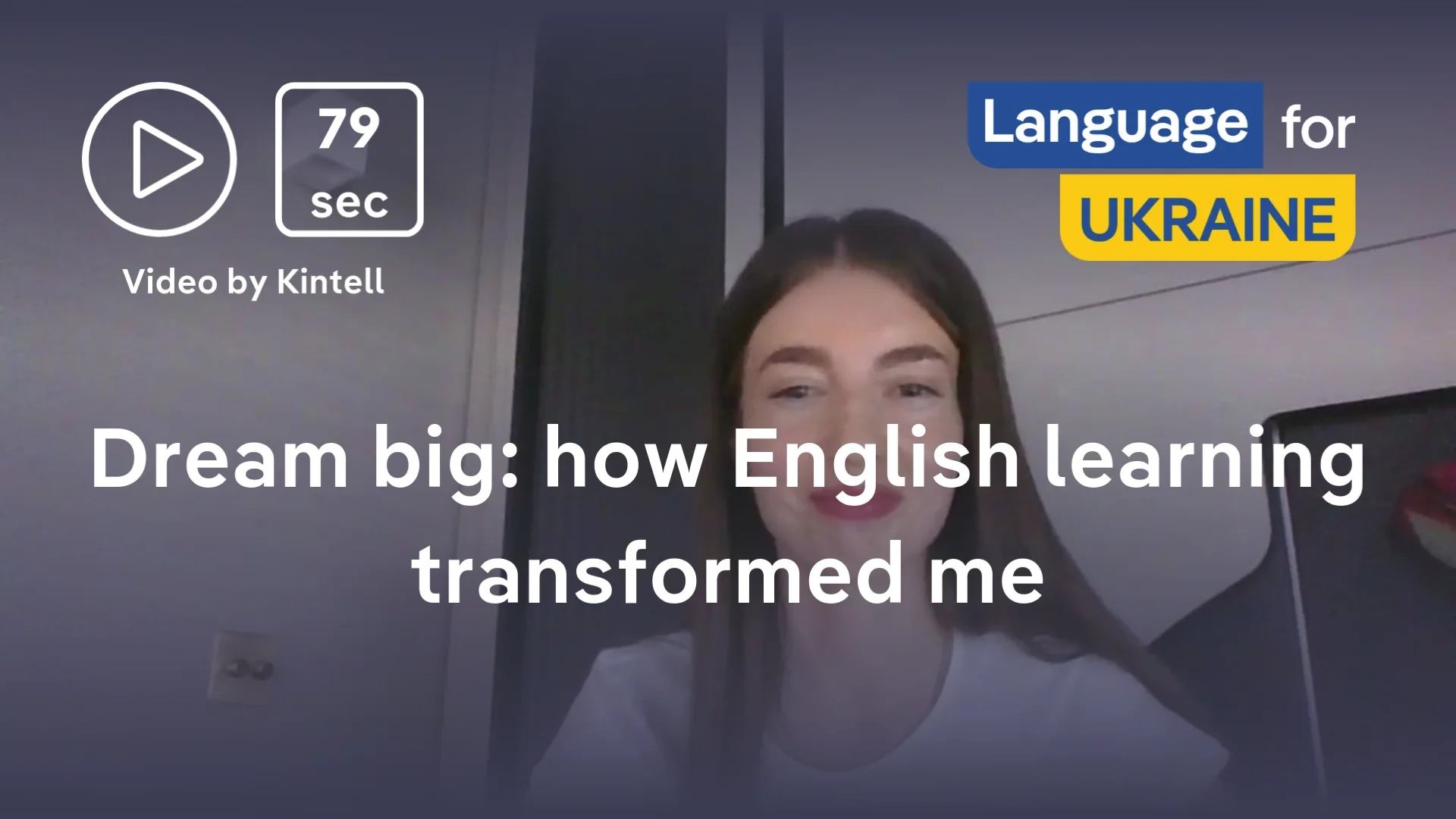
After the invasion, Viktoriia found hope in something modest: a recurring appointment to practise English. When everything felt uncertain, the session gave her structure, something to prepare for, and someone to talk to outside the immediate crisis. The English practice mattered for her career. The human connection mattered just as much.
That is the terrain Language Connect works in. The hardest part of learning a new language is rarely vocabulary on a screen. It is the moment the language has to carry consequences: at a school reception desk, in a medical appointment, in a job interview, in the ordinary exchange that decides whether daily life moves forward or stalls.
Since 2022, 8,000+ Ukrainians have used the programme for one-to-one conversation practice with volunteer partners around the world.
When Language Has to Work
Millions of Ukrainians displaced by war have had to rebuild daily life in languages that now carry unusual weight. Housing applications, medical appointments, school enrolments, job interviews, workplace small talk, a first conversation with a manager: none of these moments look like a lesson.
Language apps and formal courses still matter. They help with vocabulary, structure, and repetition. But they do not fully prepare someone for the unpredictability of being interrupted, misunderstood, corrected, or asked to explain themselves on the spot.
Confidence is built elsewhere: in live conversation, where meaning has to survive pressure.
The Part No Course Can Simulate
Language Connect offers free one-to-one video conversation practice. Ukrainians affected by war can browse volunteer profiles, choose by language and availability, book a session, and use that time to rehearse whatever the next week is likely to demand.
It is not a course and it is not a tutoring marketplace. It offers something simpler: repeated access to live conversation with real people. The platform handles matching, scheduling, time zones, and video calls. The learner-facing reality is even simpler: two people show up and talk.
Inside a session
Most sessions last 30 to 60 minutes. The learner sets the direction based on what would make the next week easier. That might mean:
- rehearsing answers before a job interview
- talking through a doctor’s appointment or school conversation
- practising pronunciation and listening comprehension
- working on workplace language and professional tone
- simply getting used to speaking without freezing
There is no rigid curriculum. The goal is simple: keep speaking until the language feels more usable outside the session.
What Repetition Changes
The shifts are often less dramatic than outsiders expect. Fluency does not arrive all at once. What returns first is willingness: to answer sooner, to stay in the sentence longer, to recover after a mistake.
For Viktoriia, regular appointments brought structure during a period of uncertainty and a sense that someone outside the crisis still had time for her. For Iryna, 18+ months on the platform turned tutors into friends and routine practice into professional competence: the ability to write work emails, follow meetings, and pick up where the last conversation left off instead of starting over every time.
Andrii, a student, values something else: hearing accents, expressions, and ways of thinking from volunteers in the UK, the US, Germany, and France. Valeriia is blunt about pronunciation: a book cannot correct a sound in real time. A person can.
What these accounts share is repetition. The session itself is small. The effect accumulates.
The Scale of Showing Up
Because each session is small, scale can look abstract from the outside. It is not abstract inside the routine.
Since launching in 2022, the programme has grown without changing its basic idea:
- 8,000+ Ukrainian learners
- Hundreds of volunteer conversation partners
- Thousands of one-to-one sessions
- Hundreds of new users joining each month
The volunteer role is deliberately narrow. Volunteers do not need teaching credentials. They do not need to design lessons or grade homework. They need fluency in at least one language, comfort with video conversations, patience, and the willingness to keep a conversation moving when someone is searching for words.
That is part of why the model lasts. People can contribute in ways that fit ordinary life:
- one conversation a week
- a few sessions each month
- a small recurring block of time that stays manageable
For many volunteers, the change is visible over time. Learners who once stalled out begin to hold the thread of a sentence, phrase things more clearly, and recover more quickly from mistakes. The totals matter, but repeat use says more than reach alone.
Charmaine De’Ath has completed 707 language tutoring sessions through the platform. Amy Frewing has completed 355. On the learner side, Lesia has attended 375 sessions while rebuilding her life in a new country.
These are not one-off registrations. They reflect routine use over time, hours turned into habit.
That continuity is also recognised through the Professional Credential System, which documents sustained contribution for both volunteers and learners. But the stronger evidence is older and simpler: people keep coming back.
A Bridge, Not a Destination
For some learners, conversation practice is not the destination. It is the bridge between study and the next practical step toward work.
A learner taking technical courses can use Language Connect to practise industry vocabulary aloud. A participant preparing for Mentors for Ukraine can rehearse answers before meeting with a professional mentor. Others use the sessions to make training, interviews, or workplace conversations feel less precarious.
The value is continuity. When speech feels more usable, the next form of support has a better chance of landing.
The programme is built around a simple assumption: displacement interrupts continuity, not capability.
Most people in Language Connect had careers, routines, and professional identities before displacement. What has changed is the environment in which those abilities have to be expressed.
That is why the structure matters. Learners browse. Learners choose. Learners book. Volunteers arrive as conversation partners rather than rescuers.
What Conversation Restores
Language recovery rarely arrives as a dramatic breakthrough. More often, it returns in smaller, quieter ways: a question understood the first time, an appointment handled without translation, an interview answer finished without panic.
Those moments do not sound historic. In a displaced life, they often decide what becomes possible next.
Conversation is only one part of rebuilding a life. But it is the part where capability becomes audible again. Before mentoring can help, before training lands, before work opens up, someone has to speak and be understood.
Practical paths, kept simple: Ukrainian learners can find a conversation partner or read the sign-up information in Ukrainian. Potential volunteers can become a conversation partner, and workplace teams can explore corporate volunteering.